

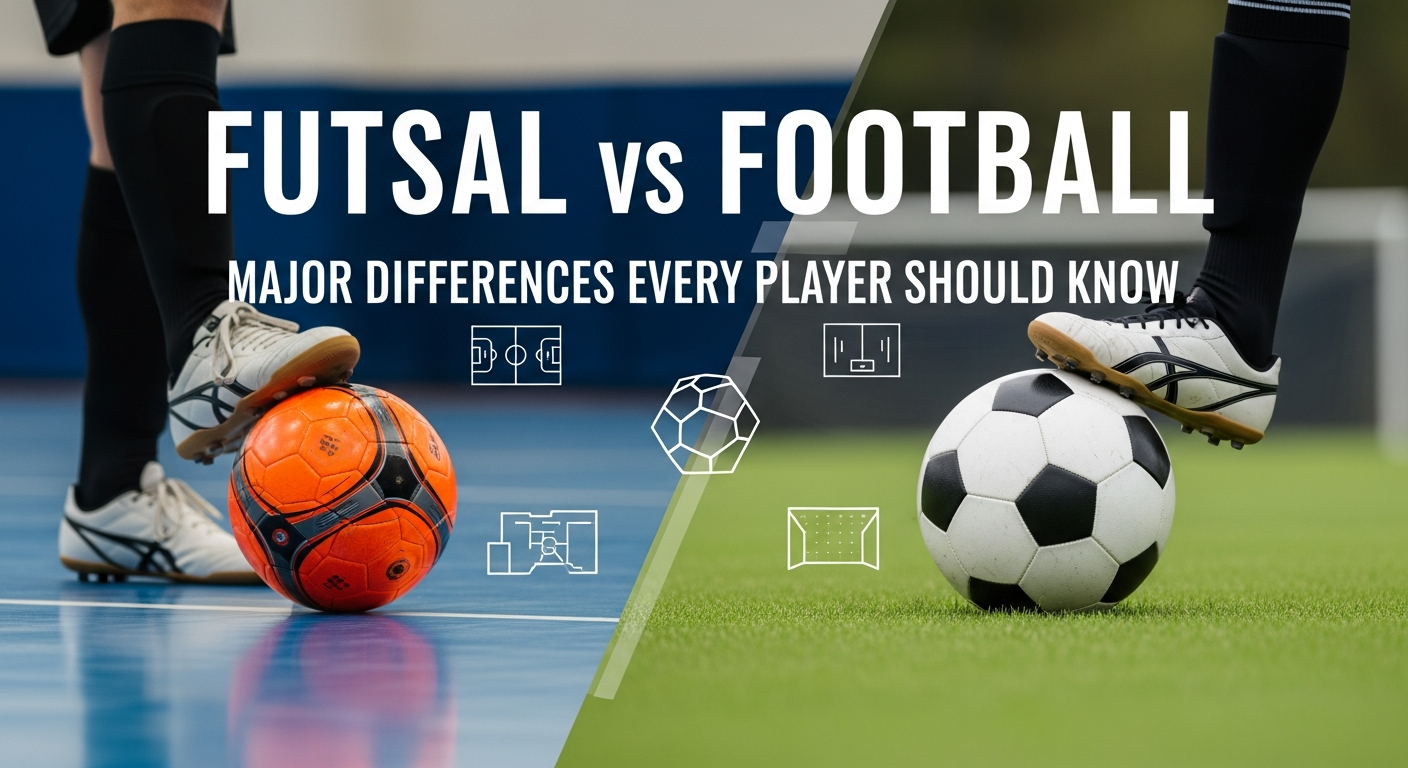
You watch Lionel Messi or Neymar Jr. navigate tight defences with absurd ease and wonder, “Where did they learn that close control?” The answer lies away from the sprawling green fields, on the hard, compact courts of futsal.
For many sports enthusiasts, football is the grand spectacle— the 90-minute war of attrition. But futsal is the forge where technique is hammered into perfection. If you have ever debated futsal vs football with your teammates, or if you are a parent deciding which path your child should take first, you need to understand the mechanics that set these two apart.
Let’s understand the technical DNA of both sports, so you can decide which game suits your style, or how one can elevate the other.
Futsal vs. Football: At a Glance
| Feature | Football (Soccer) | Futsal |
| Players | 11 vs 11 | 5 vs 5 |
| Surface | Grass/Artificial Turf | Hard Court (Wood/Synthetic) |
| Ball | Size 5, High Bounce | Size 4, Low Bounce (Heavier) |
| Match Time | 90 mins (Running Clock) | 40 mins (Stop Clock) |
| Offside Rule | Yes | No |
| Restart | Throw-in | Kick-in |
| Coaching | Limited sideline instruction | Constant tactical adjustment |
The Battlefield: Constriction vs. Expansion
The most immediate difference smacks you in the face the moment you step onto the pitch.
In standard football, you operate on a massive canvas. A standard 11-a-side field (roughly 100-110m x 64-75m) allows for long searching passes, sweeping crosses, and sprints that test your lung capacity.
Futsal is claustrophobic by design. Played on a hard court (like basketball or handball surfaces), the dimensions shrink to roughly 40m x 20m. You don’t have time to look up and admire the view. An opponent is always in your personal space.
If you hide in football, you might go unnoticed for 10 minutes. In futsal, if you zone out for 10 seconds, your team concedes.
The Tool of the Trade: Futsal Ball vs. Football
Here is where the physics change. A standard size 5 football is lighter and bouncier, designed to fly. It encourages aerial duels and long-range shooting.
The futsal ball vs football comparison reveals a deliberate design choice to keep the game on the floor. A futsal ball is a Size 4, but it is heavier and filled with foam or distinct bladders to reduce bounce (roughly 30% less bounce).
Why does this matter?
Football: You control the ball with your instep or laces.
Futsal: You control the ball with the sole of your foot. The low bounce forces you to trap the ball instantly, allowing for rapid changes in direction.
The Clock and The Chaos
Football is a game of flow. The clock runs for 45 minutes straight, pausing only for halftime. Stoppage time is an estimate, a dramatic guess at the end.
Futsal is a game of precision timing. You play two halves of 20 minutes, but it is a “stop-clock” system. The ball goes out? The clock stops. A foul? The clock stops. This means a 40-minute match ensures 40 minutes of pure action. There is no time-wasting to preserve a lead.
Rules That Alter Behaviour
The Offside Trap: It doesn’t exist in futsal. You can camp out by the opponent’s goal if you wish, though the small court makes this tactically risky. In football, the offside rule dictates the entire defensive line’s movement.
Restarts: In football, you throw the ball in. In futsal, you have four seconds to kick the ball back into play. Hesitate, and you lose possession.
Substitutions: Football has limits (though increasing). Futsal allows unlimited, rolling substitutions. You can sprint until your lungs burn, swap out, recover, and go back in.
Why the “Micro-Game” Builds Better Players
You might ask, “Why bother with the small court if my dream is the big stadium?”
Look at the top 10 football clubs in India. Giants like Mohun Bagan Super Giant, Mumbai City FC, or Bengaluru FC. Their academies are increasingly integrating small-sided games into their curriculum. Why? Because futsal forces you to develop football skills that large fields forgive.
In a crowded 5v5 game, you touch the ball 600% more often than in an 11v11 match. You learn to escape pressure in a phone booth. When you eventually step back onto the big grass field, it feels like you have all the time in the world.
Pro Tip: If you want to improve your stamina, don’t just run laps. Football stamina training involves high-intensity interval sprints that mimic the stop-start nature of a match. Futsal naturally provides this conditioning because there is no “jogging phase.”
Ready to Play?
You don’t need to sign a pro contract to experience this. You need a venue, a ball, and a few friends.
Finding the right spot used to be a headache of phone calls and mixed-up schedules. Khelomore changes that. When you look to find a coach or book a venue on our app, we strip away the confusion.
Every court listing clearly displays:
- Precise geotags so you aren’t driving in circles.
- Real-time availability slots.
- Highlights like floodlights, changing rooms, and parking.
Conclusion
When looking at Futsal vs Football, the debate shouldn’t be about choosing one over the other. It is about understanding how they feed each other. Futsal sharpens the mind and feet; football tests the lungs and tactical vision. It all depends on your goals to choose one or the other. Of course, you can also play both for leisure!
So, what will it be today? The expansive glory of the grass or the fast-paced intensity of the court?
FAQs
Do I need different shoes for futsal?
Yes. You require flat-soled indoor shoes for futsal. They should have non-marking rubber outsoles to ensure grip on hard courts. Never use standard football cleats or studs, as they have zero traction on these surfaces.
Are futsal goalkeeper rules different from football?
Drastically. Futsal keepers must release the ball within four seconds using hands or feet. Furthermore, they cannot receive a back-pass from a teammate unless the ball has crossed the halfway line or touched an opponent.
Is futsal better for fitness than regular football?
It provides higher intensity in shorter bursts. Futsal can burn over 600 calories per hour due to constant movement and sprinting, whereas 11-a-side football often involves periods of walking or jogging, depending on your position.
How instantly can I book venues on Khelomore?
Booking is immediate. Simply download and open the app, select your preferred sport and location, view real-time slot availability, and confirm your payment. You receive an instant booking confirmation code without ever needing to call the venue.
Can I find certified coaches through Khelomore?
Absolutely. Set the location, and you can browse profiles of certified trainers and academies near you. You can filter by experience level, read user reviews, and book training sessions directly through the platform.