
Futsal Positions: How Each Role Contributes to Team Success
Futsal moves fast. With only five players on court, every position carries real weight. Unlike football, where a player can hide in one role for 90 minutes, futsal demands constant rotation. Players make quick decisions. They need to understand exactly what their position is meant to do.
If you are new to futsal or trying to build a stronger team, start with the basics. Learn what each position does. This guide breaks down every futsal player position. It explains what each role is responsible for on the court. It also shows how these roles fit into common team formations. By the end, you will know how each player adds value to a winning system.
What Are the Positions in Futsal?
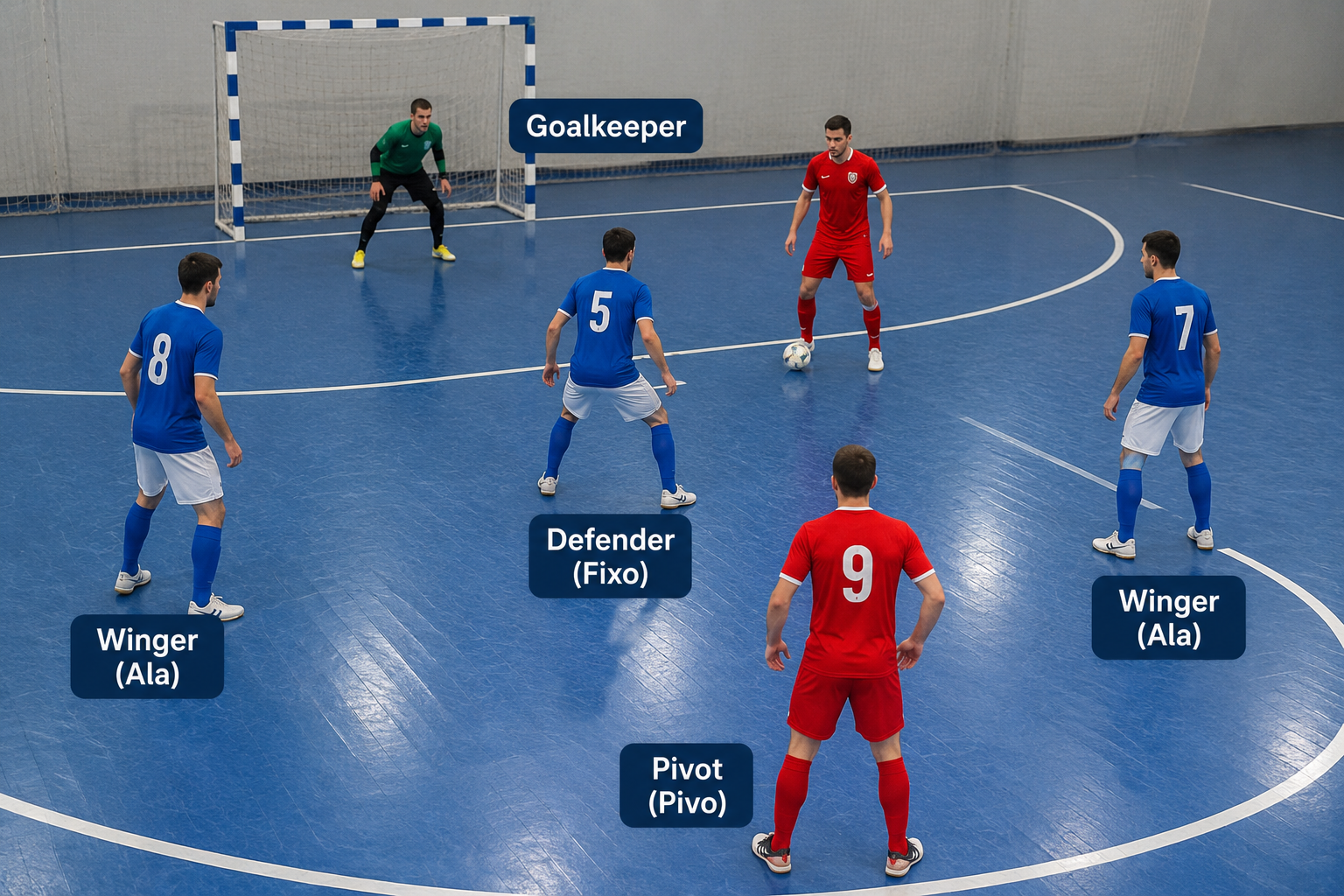
Futsal is played 5-a-side. That means one goalkeeper and four outfield players. The outfield positions are the defender (fixo), two wingers (alas), and the pivot. Football uses rigid formations. Futsal does not work that way. Positions stay fluid, and players interchange constantly. Each role has a main job, but every player helps in both attack and defence during a match.
Here is a quick look at all five futsal positions before we go into detail:
| Position | Also Known As | Primary Focus |
| Goalkeeper | GK | Shot-stopping, distribution, organising defence |
| Defender | Fixo | Marking, interceptions, building attacks from deep |
| Winger | Ala | Linking defence and attack, width, dribbling |
| Pivot | Pivo | Hold-up play, finishing, creating space |
| Universal | Flex player | Filling any outfield role as needed |
Goalkeeper: The First and Last Line
The futsal goalkeeper does more than stop shots. The court is small. The ball moves fast. Because of this, the goalkeeper also acts as the team’s first attacking option and its loudest organiser.
Key responsibilities include:
- Shot-stopping: Reacting to close-range shots with hands and feet. The four-second possession rule keeps play moving fast, so reactions must be quick.
- Distribution: Restarting attacks with a fast, accurate throw or pass instead of a long clearance.
- Communication: Directing the four outfield players. The goalkeeper has the clearest view of the whole court.
- Acting as an extra outfield player: Teams sometimes push their goalkeeper forward as a “line goalkeeper.” This creates an extra attacker.
A good futsal goalkeeper needs sharp reflexes and calm decision-making under pressure. They also need to feel comfortable playing the ball with their feet, much like a sweeper-keeper in football.
Defender (Fixo): The Anchor of the Team
The fixo is the deepest outfield player. They sit just ahead of the goalkeeper. The role sounds purely defensive, but it is central to how a team builds its attacks too.
Main responsibilities:
- Marking and interceptions: Staying tight to opposition attackers. Reading passing lanes to win the ball back.
- Organising the defensive shape: Directing wingers and the pivot. This keeps the team balanced when it does not have the ball.
- Starting attacks: Playing the first pass out of defence. This is often a long ball to the pivot or a diagonal pass to a winger.
- Occasional forward runs: Futsal rewards overlapping movement. A confident Fixo will sometimes carry the ball forward. They may also shoot from a distance when space opens up.
A strong defender needs good positional sense. They also need to stay calm under pressure and spot passing options early.
Winger (Ala): The Engine Room
Wingers operate in wide areas. They are often the most active players on the court. They also cover the most distance during a match. The fixed anchors defence. The pivot leads the attack. Wingers connect the two.
Their role includes:
- Dribbling and 1v1 play: Beating a marker in tight spaces to create an overload.
- Tracking back: Recovering into defensive positions the moment the team loses the ball.
- Combination play: Linking passes between the fixo and pivot to keep possession moving.
- Providing width: stretching the opposition defence so the pivot has more room to work.
Futsal wingers often switch between attack and defence. Because of this, stamina and tactical awareness matter as much as technical skill.
Pivot (Pivo): The Attacking Focal Point
The pivot plays with their back to the goal. They are usually the furthest player forward. People link this position with goal-scoring, but a good pivot creates chances just as often as they finish them.
Core responsibilities:
- Hold-up play: Shielding the ball under pressure from a defender. This buys time for teammates to join the attack.
- Finishing: Converting chances inside the box, often with a quick turn or a first-time shot.
- Creating space: Dragging a defender out of position. This opens gaps for wingers to exploit.
- Layoffs: A smart pivot does not always shoot. Instead, they lay the ball off to an incoming winger or fixo for a better shot.
Physical strength and composure under contact matter here. The pivot regularly plays with a defender pressing from behind.
How Positions Work Within a Formation
Positions only make sense inside a formation. The shape decides where each player starts. It also decides how they rotate. Two systems are used most often in futsal:
- 1-2-1 (Diamond): One fixed at the back, two wingers in the middle, and one pivot up front. This is the most balanced setup. It gives teams a clear passing structure between all four lines.
- 2-2 (Square): Two defenders and two attackers, split evenly. This formation is simple to learn. Newer teams like it because it does not need a specialist pivot.
Some teams use a 3-1 shape for a more defensive approach. Others use a 4-0. Here, all four outfield players rotate freely with no fixed positions. No matter the formation, the core futsal positions and roles stay the same. Only the starting shape and rotation patterns change.
Universal Players: The Modern Futsal Advantage
Many top-level teams now train players to become “universals.” A universal player can fill any outfield role well. This flexibility lets a team change shape mid-match without a substitution. It is one reason coaches now focus on position-specific training rather than just general match play. If your team is planning a friendly or a five-a-side tournament, learn these roles first. It makes it much easier to assign players and rotate them without confusion.
How to Play Each Futsal Position Effectively
Learning a position is one thing. Playing it well under match pressure is another thing entirely. Here are a few practical pointers for each role:
- Goalkeepers should practise quick outlet passes under the four-second rule, not just shot-stopping.
- Defenders benefit from reading the game a step ahead. Try to predict where the next pass will go instead of just reacting to it.
- Wingers should focus on conditioning. Their role demands the most repeated sprints between the two boxes.
- Pivots need to work on receiving the ball side-on rather than square to goal. This makes it easier to shield the ball and turn.
Coaches often rotate players through multiple positions during training. This builds a well-rounded understanding that pays off when a formation needs to shift mid-game. A structured football academy session can help drill these roles properly, rather than relying solely on match play.
Understanding these responsibilities is only half the job. Regular game time is what sharpens position-specific skills. Khelomore lists a futsal tournament and other small-sided events across cities, along with open community games. This makes it easier to find a court and start using these roles in real matches.
Conclusion
Every futsal position, from goalkeeper to pivot, plays a specific part in how a team attacks, defends, and moves between the two. Understanding these roles gives players and coaches a clear framework. This holds true even as roles shift within formations like the 1-2-1 or 2-2. That framework helps build a team that works well together. The best futsal sides are not the ones with the most talented individuals. They are the ones where every player understands their job and does it consistently. Once you know these roles, the next step is simple: get on the court and put them into practice. Platforms like Khelomore make this easier. You can find matches, tournaments like the CSL Pune futsal cup, and coaching sessions to do exactly that.
FAQs
How many positions are there in futsal?
Futsal has five positions in total: goalkeeper, defender (fixo), two wingers (alas), and pivot (pivo). Four outfield players plus a goalkeeper make up a standard futsal team. Each position carries its own set of attacking and defensive duties.
What is the most important position in futsal?
No single position matters more than the others. Futsal depends on all five players contributing to both attack and defence. That said, people often highlight the goalkeeper because of the four-second rule and their role in starting quick attacks.
Can players switch positions during a futsal match?
Yes. Futsal actively encourages players to switch positions. Players often rotate between winger, defender, and pivot roles depending on where the ball is and how the opposition sets up. This differs from the fixed roles seen in traditional football.
What is a pivot in futsal?
The pivot is the most forward outfield player. They usually play with their back to the goal. Their main job is holding up the ball under pressure, creating space for teammates, and finishing chances close to the goal.
What is the difference between a fixo and a defender in football?
A fixed player plays a deep role, similar to a football defender. But the smaller court gives them more attacking duty. Fixos often start attacks with the first pass. They sometimes push themselves forward when the situation allows.
Do all futsal teams use the same formation?
No. The 1-2-1 diamond and 2-2 square are the most common formations. Teams pick their shape based on player strengths, the opposition, and the match situation. Formations can also change mid-game without substitutions if players are trained as universals.
What skills does a futsal winger need?
Wingers need strong dribbling skills and quick decision-making in 1v1 situations. They also need the stamina to track back on defence after every attacking run. Since they connect the fixo and the pivot, accurate passing under pressure matters too.
Is the goalkeeper’s role different in futsal compared to football?
Yes. Futsal goalkeepers handle the ball with their feet far more often. They act as an active outlet for attacks, not just a shot-stopper. The four-second rule also forces quicker decisions than in traditional football goalkeeping.