

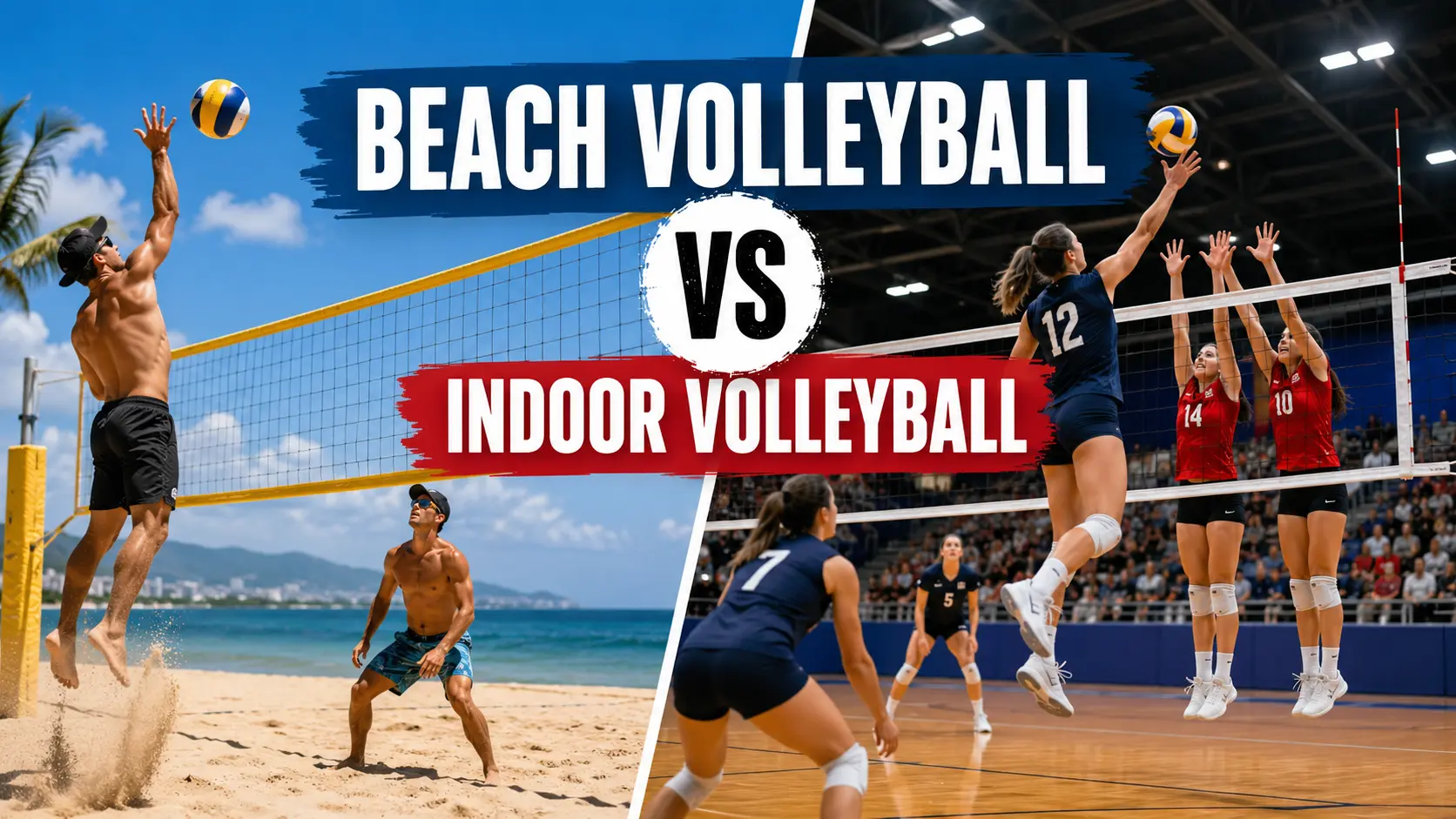
There’s a moment every indoor volleyball player knows— the first time they step onto sand and realise their footwork means nothing. The jump is slower. The dig lands differently and suddenly every skill they spent years building feels slightly out of reach.
The reverse is equally true: a beach player walking into an indoor gym for the first time is thrown off by the pace, the rotations, and the sheer number of bodies on the court. That disorientation is an actual structural gap between the two sports. These are two distinct games having the same name.
Whether you are seeking passionate gameplay, benefits of indoor games for health or the zeal of an outdoor sport adventure, knowing the distinction “Beach volleyball vs Indoor volleyball” clears a lot of doubts.
Beach Volleyball vs Indoor Volleyball: Major Differences
The fastest way to understand the comparison “beach volleyball vs indoor volleyball” is to stop treating one as a variation of the other. Yes, there’s a net, a ball, and the same basic objective. But the rules, team sizes, court dimensions, ball specs, and physical demands diverge sharply enough that players train for each format separately.
| Feature | Beach Volleyball | Indoor Volleyball |
| Team Size | 2 players per side | 6 players per side |
| Court Size | 16 m × 8 m | 18 m × 9 m |
| Net Height (Men) | 2.43 m | 2.43 m |
| Net Height (Women) | 2.24 m | 2.24 m |
| Sets to Win | Best of 3 (first to 21, final set to 15) | Best of 5 (first to 25, final set to 15) |
| Scoring System | Rally scoring in all sets | Rally scoring in all sets |
| Ball Type | Softer, slightly larger, lower pressure | Harder, standard pressure |
| Libero | No | Yes |
| Substitutions | No | Up to 6 per set |
| Open-Hand Setting Rules | Stricter | More lenient |
| Surface | Sand | Hardwood or synthetic flooring |
| Time-Outs | 1 team time-out per set (30 seconds) + technical time-outs | 2 team time-outs per set (30 seconds each) + technical time-outs |
Court Size
The doubt about beach volleyball court size vs indoor is one of the first things players notice. It tells you a lot about how each game is designed.
An indoor volleyball court is 18 metres long and 9 metres wide with a 3-metre attack line dividing the front and back zones on each side. The total playing area is 162 square metres shared by six players.
A beach volleyball court is 16 metres long and 8 metres wide. It is 128 square metres covered by two players. That’s a smaller court with fewer people. But those two players have to cover every centimetre of it, every rally, every set.
There is no attack line on a beach court. Any player can attack from anywhere. That rule shift alone changes offensive strategy completely.
Change in Game Rules
Team Size and Rotation
Indoor volleyball goes with six players who rotate positions clockwise every time their team wins back the serve. Each position has a defined role, viz., setter, libero, outside hitter, opposite, middle blockers.
Beach volleyball gives you two players and no rotation requirement. Both players serve (alternating each game), defend, and attack. One player usually takes the primary setting role. But there’s no positional lock-in. Adaptability is the whole game.
The Setting Rule
This is where the comparison “beach volleyball rules vs indoor” diverges most sharply.
In indoor volleyball, setting standards are firm but have room for interpretation. A double contact is called when the ball visibly contacts two parts of the hand separately. Lifts are called when the ball is caught or thrown. But referees allow some degree of imperfection, especially on hard-driven balls.
In beach volleyball, the standard is significantly stricter.
- A double contact is called on any set where the ball makes contact with two parts of your hand that aren’t simultaneous.
- Spin on the ball after a set is treated as evidence of a double and referees watch for it closely.
- On an open-hand set, the ball must leave cleanly. The moment there’s prolonged contact or spin, it’s a foul.
This is why experienced indoor setters get called immediately when they try to run their normal technique on sand. The motion that reads as clean in a gym reads as a lift or double on a beach court.
Blocking and Attack Rules
In indoor volleyball, a block touch does not count as one of the team’s three contacts. A player can block and then immediately play the ball as the first of three hits.
In beach volleyball, a block does count as one of the three contacts. This fundamentally changes how beach teams defend. A block-and-dig combination that’s seamless indoors becomes a strategic decision outdoors.
Also in beach volleyball, a blocker cannot open their hand over the net to redirect a set. It is called a “joust” or a “finger action” violation and is called regularly at higher levels.
Serving Rules
Both formats use rally scoring (every rally awards a point regardless of who served). Both allow jump serves and float serves.
The one difference worth noting: in beach volleyball a serve that touches the net and lands in is a point for the server. In indoor volleyball, a let serve (net touch, ball lands in) is replayed.
Net Height: Mostly the Same
Beach volleyball net height vs indoor is the same at the standard level: 2.43m for men and 2.24m for women in both formats.
Where this gets interesting is that jumping on sand is mechanically harder than jumping off hardwood. Sand absorbs energy. Players sink slightly with every step. A player who can touch 3.2 metres comfortably in a gym will find their reach reduced on sand, which means the same net height demands more from beach players in terms of raw athleticism.
Beach volleyball also allows players to penetrate under the net with hands and feet, as long as they don’t interfere with the opponent’s play. Indoor volleyball is stricter, e.g., penetration under the net is a fault if it interferes with the opponent.
The Ball
Indoor volleyballs are made of leather. They have higher internal pressure (0.300-0.325 kg/cm²) and are designed to move fast off a hard floor. The firmer construction supports powerful attacks.
Beach volleyballs are slightly larger in circumference. They are made of water-resistant panels and inflated to lower pressure (0.175-0.225 kg/cm²). The softer, slower ball accounts for wind resistance, outdoor conditions, and the slower movement mechanics that sand creates. A beach ball hit indoors would feel floaty. An indoor ball used on sand would be nearly unplayable in wind.
Physical Demands for Each Format
Beach volleyball and indoor volleyball pull from different athletic profiles.
Indoor volleyball rewards explosive vertical jump, positional precision, and teamwork within a structured system. A specialist (libero, setter, middle blocker) can excel without needing to be a complete all-around player.
Beach volleyball rewards endurance, total-court athleticism, communication under pressure, and the ability to both set and attack from any position. There are no specialists.
In terms of conditioning, beach volleyball is widely considered the more physically demanding format. Playing multiple sets in heat, on sand, while covering half a court solo is a different kind of exhaustion than the rotation-based workload of a six-player indoor team.
But if you’re weighing the importance of physical fitness in your choice, both formats are equally good in their own way.
Cost
| Aspect | Indoor Volleyball (India) | Beach Volleyball (India) |
| Court Booking | ₹500-₹1,500 per hour (depending on the city) | ₹600-₹2,000 per hour at a dedicated beach volleyball facility |
| Ball | ₹1,000-₹3,500 for a decent training ball | ₹1,500-₹4,000 for a proper outdoor ball |
| Footwear | Volleyball-specific court shoes start at ₹2,500 | No footwear required; most players go barefoot (sand socks optional) |
Beach volleyball has fewer dedicated courts in India compared to indoor. Cities like Mumbai, Goa, Chennai, and Bengaluru have facilities, but availability is limited. Booking in advance is strongly recommended.
Which Format Should You Choose?
| Choose Indoor Volleyball If… | Choose Beach Volleyball If… |
| You want a structured, team-based sport with defined positions. | You want a two-person format that demands total athletic development. |
| You’re training for school, college, or state-level competitions (indoor volleyball is far more common in institutional Indian sports). | You’re looking for a physically intense workout that doubles as skill training. |
| You prefer fast-paced rallies and a more tactically layered game. | You enjoy reading your opponent and making split-second tactical calls with one partner. |
| You’re starting out. | You’re in a city with beach volleyball infrastructure and want an alternative competitive track. |
If you’re already playing one format, the fastest way to improve at the other is to understand the rule divergences first, particularly the setting rules and the block-counts-as-touch rule in beach volleyball. Those two adjustments alone will prevent most of the early errors.
Final Word
The question around “beach volleyball vs indoor volleyball” isn’t about which is better in the abstract. They’re built differently, they reward different things, and they develop players in different ways. The net height is the same. Almost everything else shifts.
If you’re serious about volleyball in any format, play both at some point. The game you think is harder will teach you something the other never could.
Looking to book an indoor or beach volleyball court near you? Khelomore lists verified sports venues across India so you can find and book court time without the back-and-forth.
Check availability and book your slot directly on the platform.
FAQs
Beach volleyball vs indoor volleyball, which is better?
Neither is objectively better. They develop different skills. Indoor suits players who want team structure and tactical depth. Beach volleyball builds total athleticism and one-on-one reading ability. The answer depends on your goals.
What is a beach volleyball court size in metres?
A standard beach volleyball court is 16 metres long and 8 metres wide (128 sq m). That’s smaller than an indoor court (18m x 9m).
Is beach volleyball harder on the body?
Beach volleyball carries a lower injury risk for knees and ankles because sand absorbs impact. However, it places more strain on the shoulders and lower back over time due to the constant full-body load two players carry without substitutions.
Can a beginner start directly with beach volleyball?
Yes, but the learning curve is steeper. Sand slows every movement, the setting rules are stricter, and there’s no positional cover from teammates. Most coaches recommend building foundational skills indoors first.
When did beach volleyball become an Olympic sport?
Beach volleyball was introduced at the 1996 Atlanta Olympics, over 50 years after indoor volleyball debuted at the 1964 Tokyo Games. It still is one of the highest-attended events at the Summer Olympics.