

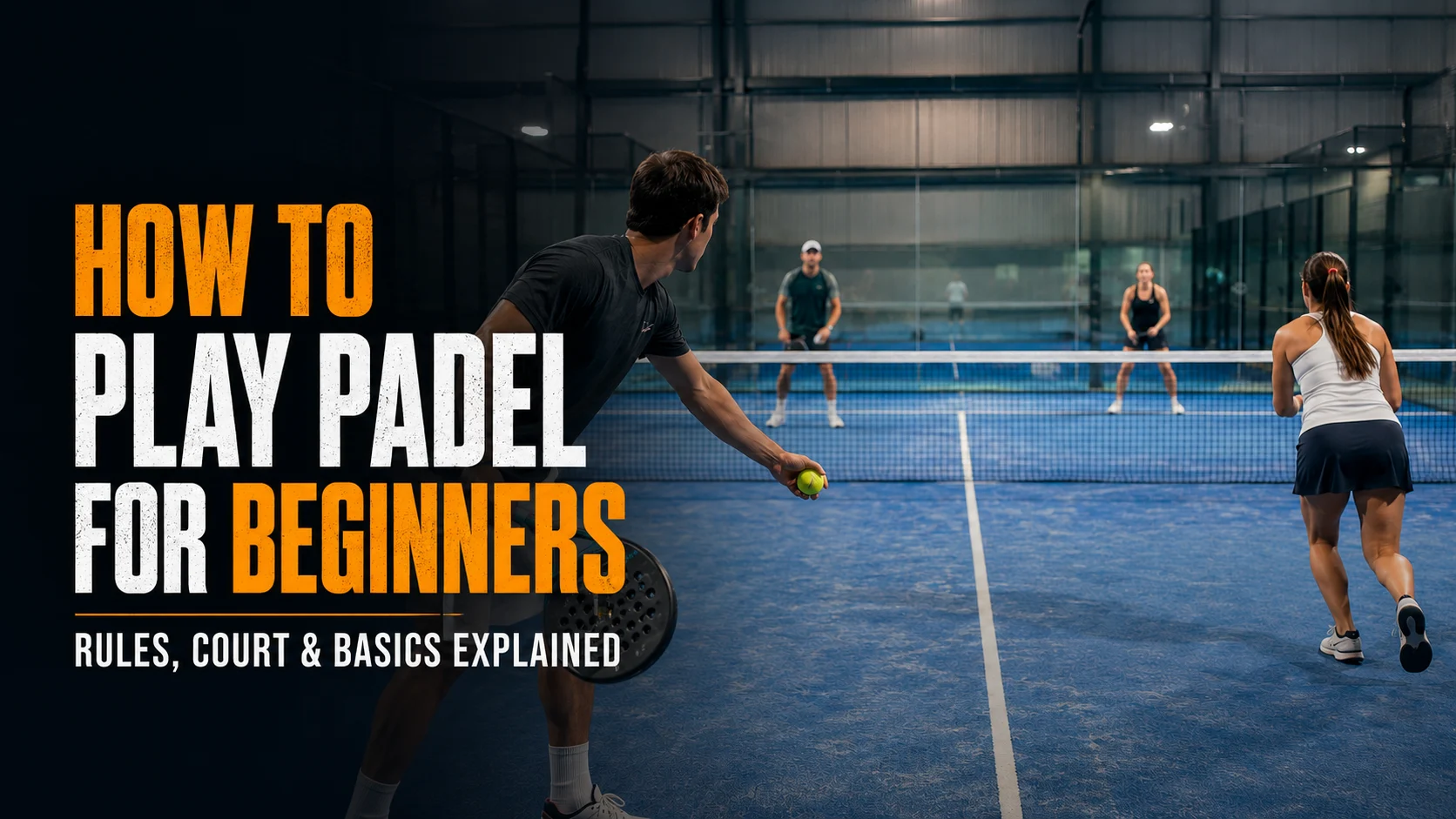
Welcome to your starting point for one of the fastest-growing racket sports in India: padel.
Part tennis, part squash, part something entirely its own, padel rewards smart positioning over raw power and turns every wall into a strategic ally.
With most Indian courts under covered roofs, it also stacks up well on the benefits of indoor games. If you’ve watched a match at a Mumbai or Bengaluru club and wondered where to begin, you’re in the right place.
This piece skips the dry rulebook recitation. Instead, you’ll learn the on-court instincts that separate someone who keeps the ball in play from someone who actually wins points. Because learning how to play padel well comes down to feel, footwork, and reading the walls.
How to Play Padel for Beginners: A Direct Guide
- Serve and move to the net: In padel, the serving team wants control at the front of the court.
- Play aggressively at the net: Aggression means smart placement and early contact, not hitting every ball hard.
- Defend from the back, then move forward fast: Use lobs to push rivals back and take net position.
- Use slice over topspin: Low slice serves and flatter shots are easier to control and harder to attack.
- Play with fresh balls: Better bounce off the glass improves rallies and shot timing.
- Learn the continental grip early: It gives better control on volleys, serves, and backhands.
- Talk with your partner: Quick communication in doubles helps both players react faster.
- Take volleys before the bounce: At the net, early contact keeps pressure on the other team.
- Move after every shot: Stay light on your feet, keep the racket up, and stay ready.
- Build stamina: Keep going to the net even when tired. Match fitness grows with regular play.
Padel for Beginners: The One Principle
Padel is a serve-and-volley sport. The team standing closer to the net wins the majority of points at every level above pure beginner.
When learning how to play padel, your instinct will pull you backward. The ball feels safer from the baseline. Resist that pull. Camping at the back may keep you in rallies, but it caps your ceiling forever. The faster you train yourself to charge forward after the serve, the faster your game evolves.
Being aggressive means hitting the ball earlier than your opponent expects. Placing it tight to a corner or cutting off their angles by standing where they don’t want you to be. Patience and aggression coexist on a padel court.
The Court Is Your Co-Player
Before your first session at any venue where to play padel is offered across India, understand the geometry. Knowing how to play padel starts with knowing the box you’re playing inside.
The court measures 20m × 10m, enclosed by glass walls (3m high) at the back and steel mesh on the sides. The ball is alive after bouncing off these walls provided it has touched the floor first.
This single feature rewrites everything you know from tennis. A ball blasted past you is not gone. It can rebound off the back glass and land softly at your feet, giving you a second chance.
| Court Element | Dimension / Detail | Why It Matters for Beginners |
| Court size | 20m × 10m | Smaller than tennis, positioning matters far more. |
| Back walls | 3m glass | Use rebounds defensively before attempting attacks. |
| Side walls | Glass + steel mesh | Mesh deadens the ball; glass keeps it lively. |
| Net height | 0.88m (centre) | Lower than tennis, flatter volleys work well. |
| Service line | 3m from net | Your reference point for transitioning to the net. |
| Players per side | 2 (doubles only standard) | Communication with your partner becomes a skill. |
Serving Without the Tennis Hangover
If tennis is in your background, your serve will betray you. Tennis players reflexively load up topspin. In padel, topspin on the serve is a gift to your opponent. It produces a high bounce they’ll punish.
Watch professional matches. The serve is sliced, flat, or carries a hint of sidespin. The bounce sis low. The return becomes awkward. Then the server rushes forward.
The “go easy on topspin” lesson extends to most strokes in padel. There are moments for it, but not the constant heavy revolutions tennis demands.
Flatter, sliced contact serves you better while you build feel for the walls. This single shift in mindset is what tennis converts learning how to play padel must internalise first.
Movement Habits To Win Points
The players who improve fastest share a handful of habits. None of them are flashy. All of them compound. They also quietly demonstrate the importance of physical fitness in a sport that looks deceptively gentle from the sidelines.
- Never stand still: Between shots, your feet stay light. At the net, hold your racket up and pointed forward, ready to block.
- Bend your knees and use your hips: Power in padel flows from your legs and core, not your wrist. Beginners who slap with the arm alone plateau quickly.
- At the net, don’t let the ball bounce: Volley it. Smash it. Take the initiative away from your opponent. Letting an attackable ball drop first hands them recovery time you can’t afford to give.
- Lob your way out of trouble: When pinned at the back, a well-placed lob over the opposing net team flips the rally. The moment they turn to chase, you sprint forward.
- Track both opponents: When your partner is defending at the back, call out which opponent has come to the net. They can’t see, you can.
Specialty Strokes
- Bandeja: A controlled overhead played at three-quarter pace to stay at the net instead of retreating.
- Víbora: A sharper, sliced overhead that skids low off the side glass.
- Chiquita: A soft, low shot dropped at the feet of net-rushing opponents to force them to lift the ball up.
- Rulo: A wristy overhead that adds sidespin and pulls opponents wide.
The Smash
The smash separates competent players from feared ones. It shares DNA with a tennis serve but demands a more contorted setup.
Twist your body sideways, bend your knees, arch your back, raise your non-dominant hand for balance, and load your hitting hand behind your head. Your body is in a diagonal stance, not upright.
Then you explode upward and through the ball, pronating your wrist on contact. Flatten it for pace, or kick it for the famous “salida” smash that bounces the ball clean out of the cage. This shot takes months. Start practising the body position long before you worry about putting balls away.
Gear Choices That Shape Your Game
Balls: Play with fresh, pressurised balls when you can. Flat balls die on the back glass and refuse to rebound usefully, forcing you to defend from positions you shouldn’t have to. A pressuriser tube extends the life of a can dramatically.
Racket: Padel rackets come in control-oriented and power-oriented shapes. Beginners default to whatever the venue rents out, and many assume their mistakes are entirely their fault. Sometimes the wrong racket is genuinely fighting you. Once you’ve played five or six sessions, test a different shape. The difference in how you find angles can be revelatory.
How to Play Padel Better
Improvement in padel is not linear. If you’ve ever read up on pickleball strategy for beginners for example, you’ll notice the parallels; both sports reward controlled net play, soft hands, and patient point construction over power.
- Warm Up: Five to ten minutes of light running and dynamic movement before you touch a racket. Stretch afterward, not before.
- Develop Your Backhand: The temptation to run around it and crush forehands is real. Resist. A reliable backhand doubles the court space you can defend.
- Know the Continental Grip: The eastern forehand grip feels natural at first, but you’ll need continental for volleys, smashes, and most overhead work.
- Don’t Quit On Conditioning Mid-match: Tired legs pull you backward and turn you defensive. Push through. Cardio builds match by match. Learning how to play padel better is partly learning to stay aggressive when fatigued.
- Communicate: Padel is a doubles sport first. Silent partners lose to talking ones, every time.
Where to Take It from Here
You now have the foundation for beginners, young or otherwise. Indeed, padel happens to be one of the kinder entry points for anyone restarting sports in their 30s.
Whatever you do, don’t fall into the trap of thinking that learning how to play padel game means memorising rules. The rules take an afternoon. The instincts take a lifetime in any game. Learning padel is also about evolving your own strategies that work exclusively for you.
Khelomore lists padel courts across India’s major cities, so finding a slot near you takes minutes.
Book your first session, find a hitting partner, and commit to ten sessions before judging your progress. By session ten, you’ll understand how to play padel in a way nothing can transmit.
FAQs
Is padel easier to learn than tennis?
Yes. The smaller court and underhand serve let beginners sustain rallies within their first session, something tennis rarely allows for months.
How long does a padel session usually last?
Standard court bookings run 60 to 90 minutes. Most clubs in India have hourly slots, which gives doubles teams roughly 8 to 12 games.
What should you wear for padel?
For padel, wear lightweight athletic clothing and non-marking court shoes with good lateral support. You can go for tennis shoes, but not running shoes.
Can you play padel solo or only doubles?
Padel is built for doubles play only. While singles courts exist, they are rare globally and almost nonexistent in India. Expect to play 2-vs-2 at every venue you visit.