

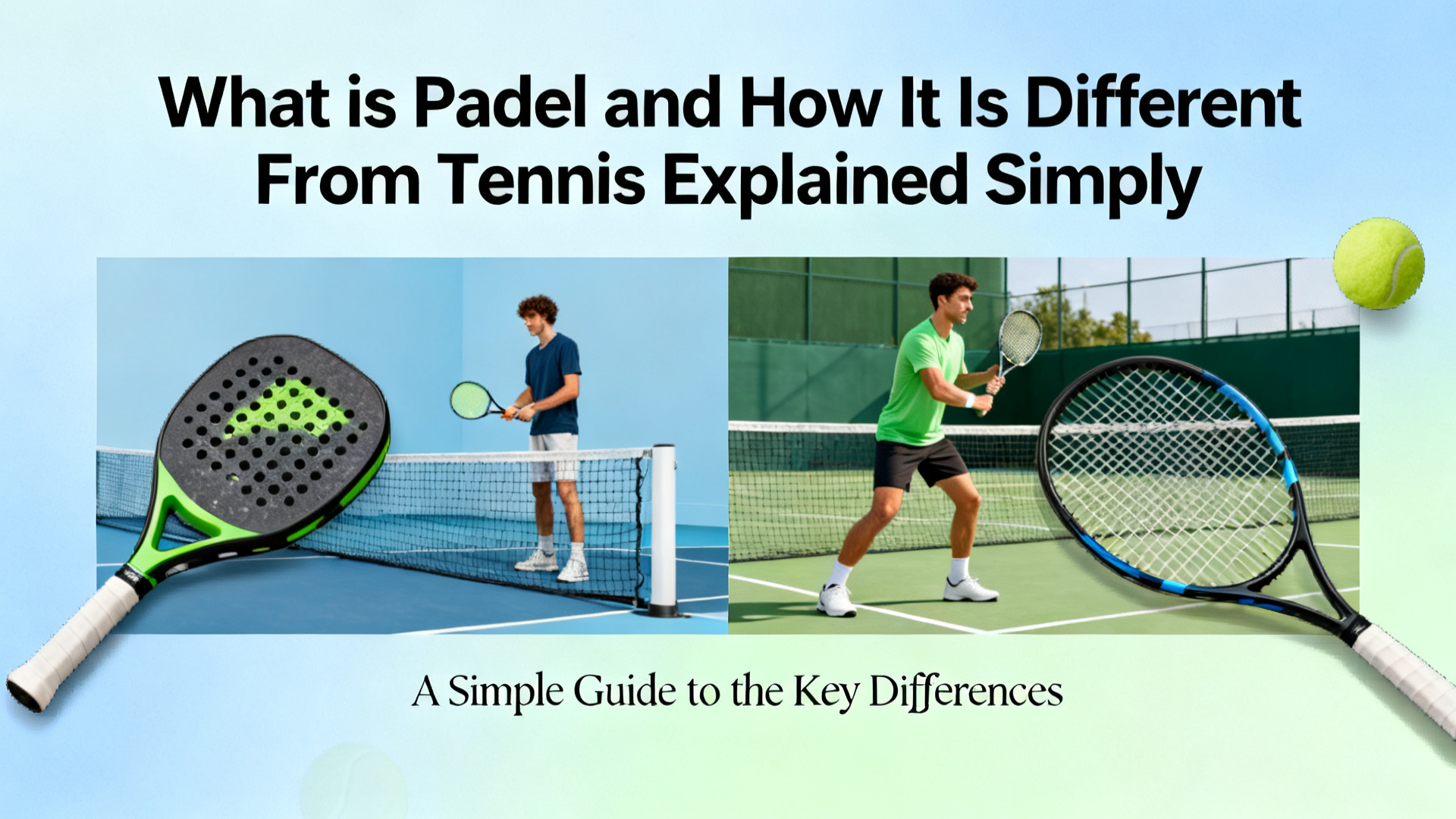
India has a new racquet sport obsession that goes by the name of Padel. From a single court in 2017, the country now has over 300 Padel courts across Mumbai, Bengaluru, Delhi, and other major cities. The Indian Padel Federation has been driving growth on the ground, and the Olympic Council of Asia (OCA) gave it credibility with a recent endorsement. Padel is the fastest-growing racquet sport in India right now. It is pulling in crowds that once reserved their weekends for tennis.
But if you’ve heard the buzz and still find yourself asking “what is Padel and how is it any different from tennis?”, you’re in the right place.
What Is Padel: The Basics
Pael is a racquet sport played in doubles on an enclosed court surrounded by glass walls and metallic fencing. It borrows the scoring system from tennis but plays out with the wall dynamics of squash. The court is roughly one-third the size of a tennis court, keeping rallies tight and action constant.
Players use solid, perforated rackets (no strings) and a depressurised Padel ball that bounces lower than a tennis ball. Serves are underarm. The walls are in play after the ball bounces, so you can let it ricochet off the glass and still return it. This rule changes the game as it rewards positioning and creative angles over brute power.
The sport was invented in Mexico in 1969. It took off in Spain and Argentina through the 1980s and today commands a following across Europe, Latin America, and the Middle East. When someone asks what is Padel in a global context, the answer is clear: a sport with over 25 million active players worldwide. India’s entry may be recent, but the trajectory has been sharp.
How Padel Is Different From Tennis
| Feature | Padel | Tennis |
| Court Size | 20m x 10m (enclosed with glass walls) | 23.77m x 10.97m (open court) |
| Racket | Solid, no strings, perforated surface | Strung racket with a larger head |
| Ball | Depressurised, lower bounce | Pressurised, higher bounce |
| Serve | Underarm only | Overarm, high speed |
| Walls | In play after the bounce | No walls |
| Format | Doubles only (in standard play) | Singles and doubles |
| Scoring | Same as tennis (15, 30, 40, deuce) | Same system |
| Learning Curve | Shorter. Accessible to beginners within a session | Longer |
The enclosed court is the biggest differentiator. In tennis, when the ball goes past you, the point is done. In Padel, the ball hits the glass and comes back. You get a second chance. Rallies last longer.
Tennis rewards power and individual dominance. Padel rewards teamwork and communication. That shift is why many recreational players find Padel far more enjoyable.
Why India’s Padel Scene Is Exploding
First, infrastructure investment picked up pace. Padel courts in India have multiplied rapidly. Cities like Mumbai, Pune, Hyderabad, and Chennai are now hosting dedicated facilities. Some operate as a Padel club, i.e., membership-based spaces with coached sessions, leagues, and community events.
Second, the sport fills a gap. Ask any recreational athlete what is Padel’s biggest advantage, and the answer will come down to accessibility. Tennis has a reputation for being expensive and hard to pick up.
Padel removes those barriers. The court is smaller. The serve is simpler and new players can hold rallies within 30 minutes. India’s growing urban population is the exact demographic Padel was designed for.
Third, platforms like Khelomore are closing the last-mile gap. Khelomore lets you search for Padel courts in India, check availability, and book a slot in seconds. The app supports 30+ sports and Padel bookings have been climbing steadily.
Padel vs Pickleball: How Do They Stack Up?
Once people learn what is Padel, they want to know how it compares to Pickleball. Both sports are new to India. But the comparison Padel vs pickleball reveals clear differences.
Pickleball is played on a smaller court (roughly badminton-sized) with a hard paddle and a plastic ball with holes. The game is slower, quieter, and emphasises soft shots near the net. It leans heavily into the recreational space.
Padel is more athletic. The glass walls add a strategic dimension that Pickleball lacks. Rallies involve overheads, lobs, smashes off the glass, and a constant need to reposition with your partner.
Neither sport is objectively better. They serve different moods. But if you’re coming from a tennis background, what is Padel going to give you that Pickleball won’t? Intensity, depth, and a longer competitive shelf life as your skills develop.
The Gear You Actually Need
Racket: Padel rackets are solid-faced with a foam core in three shapes, viz., round (control), diamond (power), and teardrop (balanced). Beginners should start with a round shape. Brands like Bull Padel rackets, Head, and Adidas dominate the market. A starter racket can cost between ₹5,000 and ₹12,000.
Balls: A Padel ball looks like a tennis ball but has lower pressure. Always use Padel-specific balls. Tennis balls bounce too high and disrupt the game.
Shoes: Court shoes with herringbone soles give you the grip and lateral support you need.
Bag: A Padel racket bag keeps your gear organised with separate compartments for rackets, shoes, and accessories.
How to Get Started
Find a court: Open the Khelomore app or visit the website. Search for Padel venues near you. Compare options and book a time slot.
Take a beginner session: Many Padel clubs and venues provide introductory coaching. They are usually 60-minute group classes.
Grab a partner: Padel is a doubles sport. Bring a friend or join a community session where venues pair you with players at your level.
Play regularly: The more you play, the faster your court sense develops.
The Road Ahead
The sport’s momentum is undeniable. What is Padel going to look like in India five years from now? Expect thousands of courts, professional Indian players on the World Padel Tour, and grassroots leagues reaching Tier 2 and Tier 3 cities.
The best part? Khelomore is removing the friction between curiosity and that first game. You can find the best venue near your place, book a coach, and join a supporting community in your search for the best facilities.
Open the app and see what the fuss is about. You’ll understand Padel within the first rally.
FAQs
Is Padel easier to learn than tennis?
Yes. The underarm serve, smaller court, and slower ball make Padel far quicker to pick up. Most beginners can rally comfortably within their first session unlike with tennis.
How long does a Padel match last?
A standard Padel match takes 60-90 minutes. Competitive matches with three sets can go longer. But most casual and club-level games wrap up within an hour.
Can you play Padel singles?
Padel is designed for doubles and nearly all courts are built for four players. Singles Padel exists as an informal variant on narrower courts, but it is rare in India and not part of official tournament formats.
Is Padel an Olympic sport?
Not yet. The International Padel Federation has been pushing for Olympic inclusion, and the OCA’s recognition of Padel for the Asian Games pathway has strengthened that bid significantly. Many expect it to feature in the 2032 Brisbane Olympics.